
California made marijuana legal, but it did not make driving high legal. It is one of the most misunderstood areas of California DUI law and one of the most aggressively prosecuted. Marijuana has been legal in California since 2016, but driving under its influence is a serious criminal offense under Vehicle Code § 23152(f). What makes marijuana DUI cases uniquely challenging is that unlike alcohol, there is no legal threshold. No .08% equivalent. No bright line. Just a prosecutor trying to prove you were actually impaired while driving.
As a Orange County DUI Lawyer and former Los Angeles prosecutor with more than 27 years defending DUI cases throughout Orange County courts, I want to give you an honest picture of exactly how law enforcement builds marijuana DUI cases and where those cases are most vulnerable to challenge.
If you or a loved one has been arrested for marijuana DUI in Orange County, acting quickly is critical. A cannabis DUI can carry the same penalties as an alcohol DUI, including jail time, license suspension, mandatory DUI school, and a permanent criminal record. An experienced DUI Lawyer Orange County can evaluate whether charges may be reduced, dismissed, or challenged through both the court and the DMV process.
DUI Marijuana California: How Police Prove Impairment: Key Takeaways
- California has no legal THC limit for driving. Prosecutors must prove actual impairment, not just the presence of THC in your system.
- THC is fat-soluble and can be detected in blood for days or weeks after use, long after any impairment has worn off.
- Officers use Drug Recognition Experts (DREs), field sobriety tests, and blood testing to build marijuana DUI cases: all of which can be challenged.
- The government’s own research, including NHTSA studies, shows no consistent link between THC blood levels and driving impairment.
- Field sobriety tests were designed for alcohol impairment, not cannabis, making their application to marijuana DUI cases scientifically questionable.
- Marijuana DUI cases are frequently more defensible than alcohol DUI cases precisely because the prosecution’s evidence is more subjective.
Why Marijuana DUI Cases Are Different From Alcohol DUI Cases
In an alcohol DUI case, the prosecution has a bright line: .08% BAC. A breathalyzer result at or above that number gives prosecutors a clear, scientifically defined threshold to point to. The case may still be defensible, but the evidentiary foundation is straightforward.
In a marijuana DUI case, that bright line does not exist.
Under California law, prosecutors must prove that you were actually impaired by marijuana at the time you were driving. The mere presence of THC in your bloodstream, even at elevated levels, does not automatically establish impairment. This is not a legal technicality. It is a scientific reality that the government’s own researchers have acknowledged.
THC metabolizes very differently from alcohol. It is fat-soluble, stored in body tissue, and released slowly over time. A chronic cannabis user may test positive for THC days or even weeks after their last use, long after any effects on driving ability have completely worn off. The blood test that shows THC might be in your blood says nothing reliable about whether you were actually impaired at the moment you were behind the wheel.
That distinction is at the center of every marijuana DUI defense.
How Police Build a Marijuana DUI Case in California

Richard Wagner, former Los Angeles prosecutor and DUI defense attorney with 27+ years of courtroom experience
When a California officer suspects a driver of marijuana impairment, the investigation typically unfolds in a specific sequence. Understanding each step: and its weaknesses: is essential to an effective defense.
Step 1: The Traffic Stop and Initial Observations
Most marijuana DUI cases begins with a traffic stop. The officer needs reasonable suspicion of a traffic violation or criminal activity to legally initiate the stop. Common triggers include swerving, driving too slowly, failure to maintain lane, or rolling a stop sign.
Once the stop is initiated, the officer begins documenting observations that may suggest impairment:
- The smell of marijuana from the vehicle or the driver
- Red or bloodshot eyes
- Slow or slurred speech
- Lethargic or confused behavior
- Visible marijuana or paraphernalia in the vehicle
- The driver’s acknowledgment of recent cannabis use
None of these observations prove impairment on their own. Red eyes can result from allergies, fatigue, or contact lenses. The smell of marijuana in a vehicle proves only that cannabis was present or recently consumed: not that the driver was impaired at the time of driving. And a driver’s acknowledgment of having used marijuana earlier in the day tells officers nothing reliable about their current level of impairment.
As a former prosecutor, I can tell you that officers are trained to document these observations in specific, standardized language. The reports often read nearly identically from case to case. That standardization is something an experienced defense attorney knows how to challenge effectively.
Step 2: Standardized Field Sobriety Tests
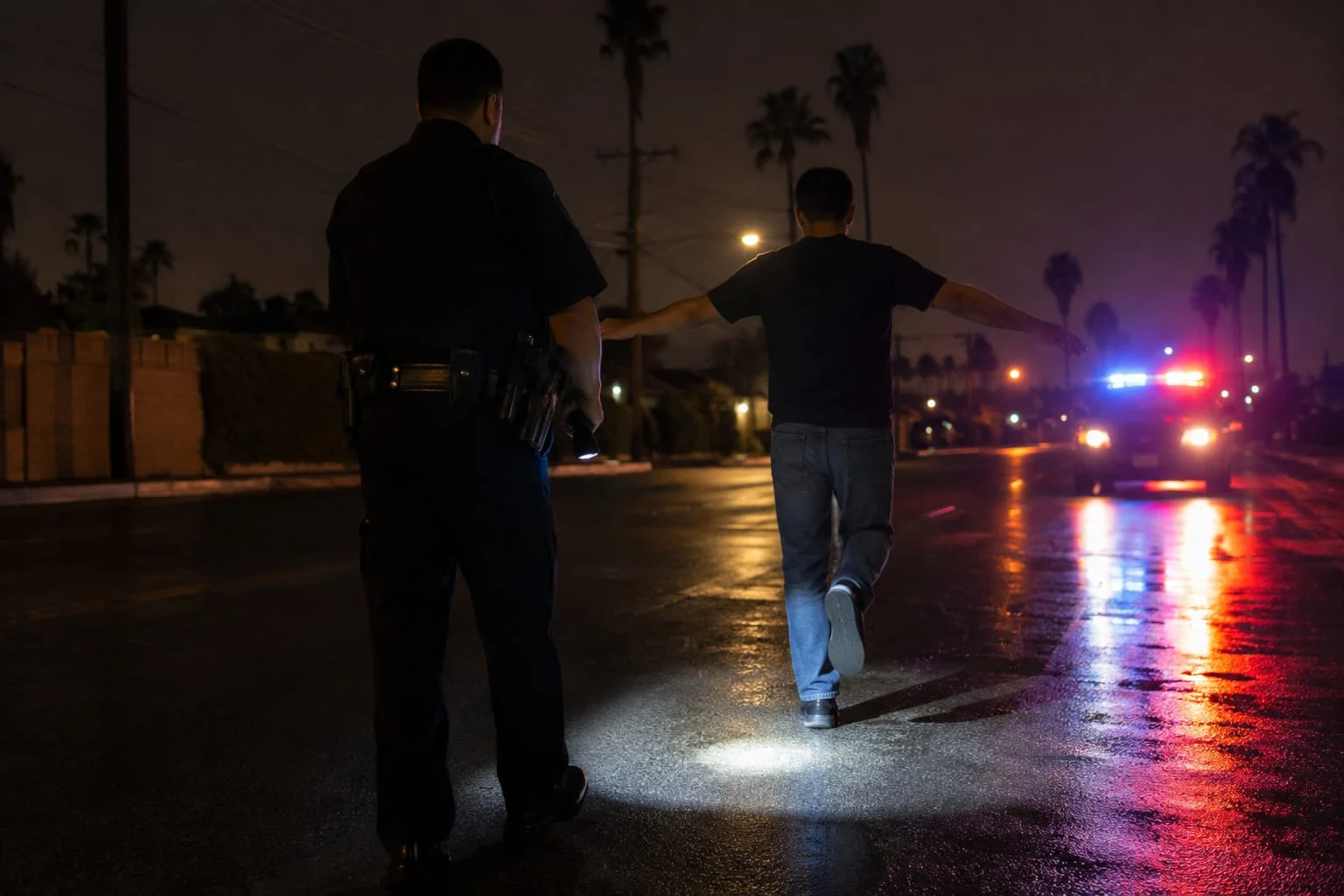
After initial observations, officers typically ask the driver to perform the standardized NHTSA-approved field sobriety tests: the Horizontal Gaze Nystagmus (HGN), the Walk-and-Turn, and the One-Leg Stand. These tests were developed specifically to help police officers identify drivers who have a blood alcohol concentration (BAC) of .08% or more. They were not designed for cannabis.
This is a critical weakness in marijuana DUI prosecutions.
The HGN test looks for involuntary eye jerking caused by alcohol affecting the central nervous system. THC does not cause horizonal gaze nystagmus in the same way alcohol does. In marijuana DUI cases, officers usually claim that you must be under the influence of cannabis because they do not find HGN.
The Walk-and-Turn and One-Leg Stand tests claim to assess balance, coordination, and the ability to follow divided-attention instructions. These can be affected by cannabis at high doses, but they are also significantly affected by nervousness, physical conditions, roadside surface irregularities, footwear, and the stress of a traffic stop itself. Officers score these tests subjectively using criteria they determine in real time.
Also, none of the Standardized Field Sobriety Test (SFTS) studies, which the prosecution and law enforcement claim to “validate” or scientifically support these roadside agility exercises, have been peer reviewed. Furthermore, the studies themselves are ancient ranging from 1977 to 1998.
As a former prosecutor, I used field sobriety test results to build DUI cases. As a defense attorney, I know exactly where those results are most vulnerable to challenge in front of an Orange County jury.
“Officer, I respectfully decline to perform field sobriety tests.”
Field sobriety tests are voluntary in California. You can decline them without automatic legal penalty.
Step 3: The Drug Recognition Expert (DRE) Evaluation
If a standard DUI investigation does not produce sufficient evidence of impairment, or if the officer suspects drug impairment rather than alcohol, they may call in a Drug Recognition Expert. A DRE is a law enforcement officer with specialized training in identifying drug impairment through a highly standardized 12-step evaluation protocol.
The 12-step DRE Drug Recognition Evaluation protocol includes:
- Breath alcohol test to rule out alcohol impairment
- Interview of the arresting officer
- Preliminary examination including pulse rate and pupil size
- Eye examinations including HGN, vertical nystagmus, and lack of convergence
- Divided attention tests: Modified Romberg, Walk and Turn, One Leg Stand, Finger to Nose
- Vital signs including blood pressure, body temperature, second pulse reading
- Darkroom examination of pupil size under 3 different lighting conditions
- Muscle tone assessment
- Injection site examination and third pulse
- Interview of driver
- Opinion of the evaluator
- Toxicological examination of blood or urine
The DRE protocol is presented in court as scientific and objective. In practice, it relies heavily on the evaluating officer’s subjective judgment at every step. It can be challenged through cross-examination of the officer’s training, the conditions of the evaluation, and the scientific literature on the protocol’s reliability.
The DRE protocol does not allow DRE officers to reliably predict whether a person is impaired by a drug, let alone for the purposes of driving a car. At most, it may allow DRE officers to reliably predict what drug a person has taken. There is no support for the DRE protocol allowing DRE officers to correctly classify people as impaired.
Step 4: Blood Testing
After a marijuana DUI arrest, you will be required to submit to a blood test under California’s implied consent law. Unlike alcohol breath testing, marijuana impairment cannot be measured by a roadside device. A blood sample is collected and sent to a laboratory: in Orange County, typically the Orange County Crime Lab for analysis. by LC/MS/MS Liquid Chromatography/Mass Spectrometry/ Mass Spectrometry.
The blood test will measure:
- Delta-9-THC: the active form of THC that causes impairment
- 11-OH-THC: 11-hydroxy-THC is a psychoactive metabolite produced during THC metabolism
- THC-COOH: 11-nor-9-carboxy-TCH is not a psychoactive metabolite that indicates past use but not current impairment
The presence of THC-COOH in blood does not establish that you were impaired while driving. It establishes only that you used cannabis at some point in the past. This distinction is enormously important in court and is frequently misrepresented or misunderstood by jurors who assume any positive THC result means impairment.
Even elevated delta-9-THC levels do not reliably predict impairment. Chronic users develop tolerance and may show elevated THC blood levels with minimal functional impairment. The government’s own research acknowledges this directly.
A basic principle of pharmacology is that it is impossible to predict the effects of any drug simply by looking at the level of the drug found in a person’s blood.
This is a distinction that matters enormously in how marijuana DUI cases are charged and defended. A former prosecutor knows exactly how these cases are built and exactly where the evidence is most vulnerable. Contact a DUI Lawyer Orange County immediately after any marijuana DUI arrest.
What the Government’s Own Research Says About THC and Driving
Marijuana DUI cases in Orange County are prosecuted in the Orange County Superior Court under Vehicle Code §§ 23152(f) 23153(f), 23152(g) 23153(g): where the prosecution’s scientific evidence is tested against defense challenges.
The National Highway Traffic Safety Administration, the federal agency responsible for reducing deaths, injuries and economic loss from car crashes and sponsor of highway safety research, has published findings that directly undermine the prosecution’s approach to marijuana DUI cases in California.
Key findings from NHTSA research:
- While the presence of THC in a driver (blood, oral fluid, etc.) does not establish impairment, it also does not distinguish between active use and environmental exposure or contamination. Some studies have shown that people exposed to second-hand marijuana smoke can test positive for THC.
- THC level in blood … does not appear to be an accurate and reliable predictor of impairment from THC. Also, when low levels of THC are found in the blood, the presence of THC is not a reliable indicator of recent marijuana use.
- There is no consistent, reliable relationship between THC blood concentration and driving impairment.
- Subjects in driving simulation studies who used cannabis often drove more slowly, followed vehicles at greater distances, and took fewer risks than when sober: behaviors that reduce rather than increase crash risk.
- After controlling for demographics and alcohol use, the presence of THC did not significantly increase crash risk in at least one large-scale NHTSA study.
- Individual variation in THC metabolism and tolerance makes group-level findings unreliable for predicting any individual’s impairment level.
- The psychoactive ingredient in marijuana, delta-9-tetrahydrocannabinal (THC), does not correlate well with impairment.
This research does not mean marijuana has no effect on driving. It means the prosecution cannot simply point to a positive blood test and declare impairment proven. They must establish through evidence: and your defense attorney can challenge every piece of it: that you, specifically, were actually impaired at the time you were driving.
How a Defense Attorney Challenges a Marijuana DUI Case
When a marijuana DUI case comes to me, these are the questions I begin asking immediately:
- Was the traffic stop lawful? The entire investigation can be suppressed if the initial stop lacked reasonable suspicion. A camera recording showing lawful driving behavior is worth examining immediately.
- Were the field sobriety tests properly administered? Studies have shown that FSTs designed for identifying drivers who are over the legal BAC limit have no correlation with the concentration of THC found in the blood.
- Was the DRE evaluation conducted by a properly certified officer? DRE certification requires specific training hours and supervised evaluations. The officer’s credentials and the conditions of the evaluation are both challengeable.
- What specific metabolites were found in the blood test? THC-COOH proves prior use. Only delta-9-THC is associated with current impairment, and even elevated levels are not conclusive. THC is stored in fatty tissues in the body and can be released back into the blood sometimes long after ingestion. Some studies have detected THC in the blood at 30 days post ingestion. Expert toxicologist testimony can explain this distinction to a jury.
- What was the chain of custody for the blood sample? Blood samples must be collected, stored, and analyzed according to specific protocols under California Title 17. Violations of those protocols can compromise the reliability of results.
- Were the driver’s observations consistent with multiple explanations? Red eyes, slow speech, and relaxed behavior have many causes. Government sponsored studies have eliminated some of police observations because they might be indicators more of social class than impairment: flushed face; bloodshot or droopy eyes; glassy, watery or glazed eyes; appearing sleepy or confused; being inattentive to the officer or being uncooperative with the officer; and being lighthearted, humorous, or jovial as observations for consideration. The prosecution must eliminate alternative explanations, not just assert that cannabis caused the observations.
Every marijuana DUI case is a collection of individual evidence pieces, and experienced defense attorneys know how to examine each link in the chain. Having prosecuted DUI cases in Los Angeles before moving to the defense side, Attorney Wagner understands how these cases are assembled: and where they fall apart.
For a full breakdown of what happens after any DUI arrest, see our guide: What Happens After a DUI Arrest in Orange County.
What Happens If You Are Arrested for Marijuana DUI in Orange County
A marijuana DUI arrest in Orange County triggers the same two-track proceeding as any alcohol DUI.
The Criminal Case
Marijuana DUI is prosecuted under Vehicle Code § 23152(f) as a misdemeanor in most cases. Penalties mirror those for alcohol DUI:
- First offense: Up to 6 months in county jail, $390 to $1,000 in base fines plus significant penalty assessments, 3 to 5 years informal probation, mandatory DUI school, and license suspension
- Second offense within 10 years: Mandatory minimum 96 hours to 1 year in county jail, extended DUI school, longer license suspension, mandatory IID
- Third offense: Up to 1 year in county jail, 18-month DUI program, potential felony filing under proposed AB 1546
- Felony DUI with injury: State prison exposure, extended probation under AB 1087, and permanent record consequences
Orange County courts, including the Harbor Justice Center in Newport Beach, the Central Justice Center in Santa Ana, the North Justice Center in Fullerton, and the West Justice Center in Westminster, each have their own prosecutors, judges, and procedural tendencies. Local knowledge makes all the difference. When you need a DUI Lawyer Orange County residents trust, experience in those specific courtrooms matters.
Possible Defenses in a California Marijuana DUI Case
Every marijuana DUI case is different, and the defenses available depend entirely on the specific facts of the arrest. As a former Los Angeles prosecutor, Attorney Wagner evaluates these cases from both sides of the courtroom. Common defense angles in marijuana DUI cases include:
- Challenging the lawfulness of the traffic stop. If the initial stop lacked reasonable suspicion, all evidence gathered afterward may be suppressible under the Fourth Amendment.
- Challenging the DRE evaluation. The Drug Recognition Expert’s credentials, methodology, and conclusions are all subject to cross-examination and expert rebuttal. The DRE protocol has significant reliability limitations that are well-documented in the scientific literature.
- Challenging the blood test results. Gaps in the chain of custody, Title 17 compliance, preanalytical error, the specific metabolites detected, and the interpretation of results are all contestable. Expert toxicologist testimony can explain to a jury why a positive THC result does not prove impairment.
- Challenging field sobriety test application. The Romberg Balance and Finger to Nose are NHTSA approved tests. The Walk-and-Turn and One Leg Stand have only been validated by NHTSA for alcohol related DUI cases. Their application to marijuana cases is scientifically disputed and can be challenged effectively at trial.
- Challenging the sufficiency of the evidence. Without a legal THC threshold, the prosecution must prove actual impairment beyond a reasonable doubt. Cases built primarily on subjective officer observations and a positive blood test without strong corroborating evidence of actual impaired driving are among the most defensible DUI cases in Orange County.
- Wet reckless reduction. In cases where the evidence of impairment is limited or contested, a reduction to a wet reckless under Vehicle Code 23103.5 may be negotiable, avoiding a DUI conviction on your record entirely.
No two marijuana DUI cases are identical. Contact DUI Lawyer Orange County Richard Wagner for a free consultation to discuss the specific facts of your arrest and what defenses may apply to your situation.
The 2026 Legal Landscape: What Has Changed for Marijuana DUI Cases
California’s DUI enforcement framework continues to evolve. Several 2026 developments are directly relevant to marijuana DUI cases in Orange County.
AB 366: Ignition Interlock Device Extension Through 2033
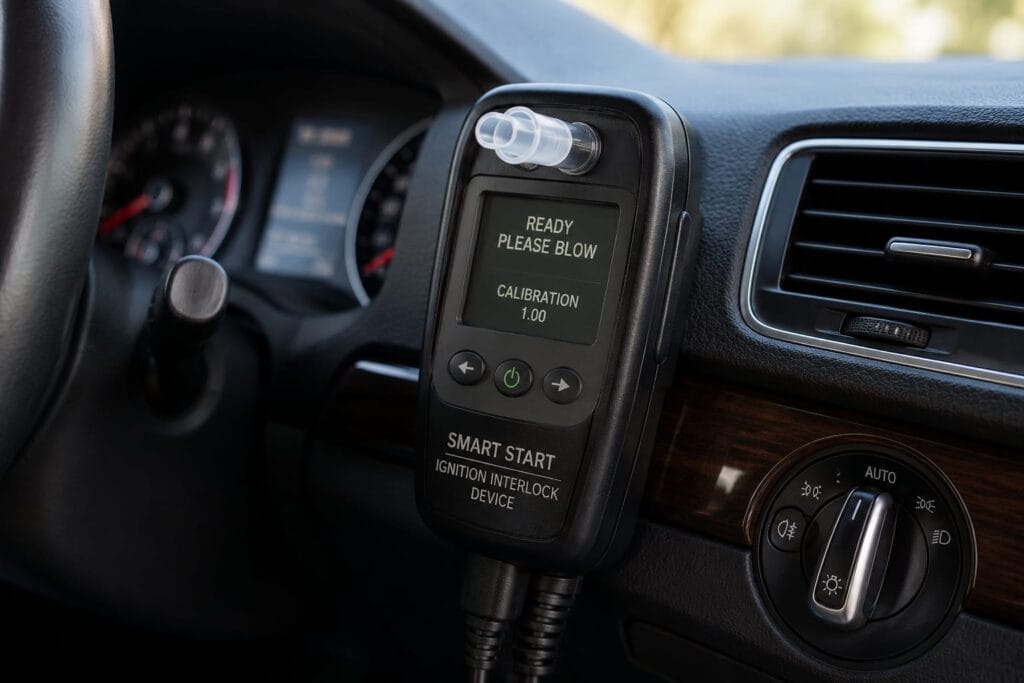
Under AB 366, California’s mandatory ignition interlock device requirement applies to marijuana DUI convictions through January 1, 2033
AB 1546: Third DUI as a Felony (Proposed)
Under proposed AB 1546, a third DUI conviction within 10 years could be charged as a felony even without prior injury. A marijuana DUI counts as a prior DUI for purposes of this calculation. Every prior conviction on record increases the stakes of any current case.
➡️ See our related post: California DUI & Traffic Law Changes 2026
Frequently Asked Questions: DUI Marijuana in California
Is there a legal THC limit for driving in California?
No. Unlike alcohol, California has no legal THC threshold for driving. Under Vehicle Code § 23152(f), it is unlawful to drive while actually impaired by marijuana. The prosecution must prove impairment, not just the presence of THC in your system. This distinction makes marijuana DUI cases significantly more defensible than alcohol DUI cases where a BAC result at or above .08% establishes a presumption of impairment.
Can I be arrested for marijuana DUI if I used cannabis legally the day before?
Yes. THC can remain detectable in blood for days or weeks after use, particularly in chronic users. An officer who observes signs of impairment may arrest you for marijuana DUI even if your last use was many hours ago. However, the detectability of THC in your blood does not prove you were impaired while driving. A skilled defense attorney can challenge the connection between a positive blood test and actual impairment at the time of the stop.
What is a Drug Recognition Expert and how can their evaluation be challenged?
A Drug Recognition Expert is a law enforcement officer with specialized training in a 12-step protocol. The International Association of Chiefs of Police (IACP) has established the national standard for training and certification for DREs. To pass the exam, the officer must link impairment with a drug in one of seven categories. DRE evaluations are presented in court as scientific and objective, but they rely heavily on the evaluating officer’s subjective judgment at every step. The DRE’s opinion as to the category of drug causing impairment is a conclusion, not a measurement. It can be challenged through cross-examination of the officer’s training and certification, the conditions of the evaluation, and expert testimony on the scientific limitations of the DRE protocol.
Do I have to take a blood test after a marijuana DUI arrest in California?
Yes. Once you are lawfully arrested for DUI in California, you are required to submit to a chemical test under California’s implied consent law (Vehicle Code § 23612). For marijuana DUI, the chemical test is a blood draw since breath testing cannot detect THC. Refusing the post-arrest blood test carries serious consequences including automatic license suspension and the ability of prosecutors to use your refusal as evidence of consciousness of guilt at trial. Note that the roadside preliminary screening is different and generally voluntary for most adults not on DUI probation.
Can a marijuana DUI be dismissed in Orange County?
Yes. Marijuana DUI cases in Orange County can be dismissed when the prosecution cannot prove actual impairment beyond a reasonable doubt, when the traffic stop lacked reasonable suspicion, when blood test evidence is challenged on chain of custody or Title 17 compliance grounds, or when the DRE evaluation is successfully contested. Cases built primarily on subjective officer observations and a positive blood test without strong evidence of actual impaired driving behavior are among the most defensible DUI cases in Orange County courts.
How is marijuana DUI different from alcohol DUI in California?
The most significant difference is the absence of a legal threshold. In an alcohol DUI case, a BAC at or above .08% creates a rebuttable presumption of impairment. In a marijuana DUI case, the prosecution must affirmatively prove actual impairment: a much higher evidentiary burden. Additionally, the scientific tools for measuring marijuana impairment are far less reliable than breathalyzer technology, giving defense attorneys significantly more to work with in challenging the evidence.
Will a marijuana DUI affect my professional license in California?
Potentially yes. A marijuana DUI conviction is a criminal conviction and must be reported to many licensing boards in California, including those governing healthcare professionals, attorneys, teachers, real estate agents, and others. The impact varies by profession and licensing board. See our detailed guide: DUI and Professional Licenses in Orange County.
How soon should I contact a DUI attorney after a marijuana DUI arrest?
Immediately. Blood evidence and witness availability also degrade quickly. The strategic decisions made in the earliest phase of a marijuana DUI case have the greatest long-term impact on outcomes. Contact our DUI Lawyer Orange County team today for a free consultation.
Orange County DUI Defense Representation
Written and reviewed by Richard Wagner, a former Los Angeles prosecutor and highly respected Orange County DUI & criminal defense attorney, representing clients throughout Irvine, Newport Beach, Santa Ana, Anaheim, Huntington Beach, Fullerton, Mission Viejo, and all of Orange County. With over 27 years of experience defending DUI cases in Orange County courts, Attorney Wagner aggressively defends:
- Marijuana DUI (THC DUI) in Orange County
- First-time DUI arrests
- Second-offense DUI
- Third and repeat DUI offenses
- Felony DUI & DUI with injury
- DMV license suspension hearings
- Wet reckless charge reductions
If you need the most trusted DUI Lawyer Orange County has to offer, contact Richard Wagner today. For a full breakdown of marijuana DUI law in California, see our practice area page: Marijuana DUI Attorney Orange County.
Disclaimer
This article is for informational purposes only and does not constitute legal advice. Laws are subject to change and proposed legislation may be amended or withdrawn before enactment. If you have been arrested for marijuana DUI in Orange County, consult a qualified attorney regarding your specific situation.
Legal Authorities
The information in this article is based on California statutes, enacted legislation, case law, federal research, and published law enforcement guidance governing marijuana DUI enforcement in California. Sources include the California Legislative Information portal, the California DMV, the National Highway Traffic Safety Administration, and published United States Supreme Court decisions.
Primary legal authorities referenced in this article:
- California Vehicle Code § 23152(f) (Driving Under the Influence of Drugs)
- California Vehicle Code § 23153 (DUI Causing Injury)
- California Vehicle Code § 23612 (Implied Consent Law)
- California Health and Safety Code § 11362.3 (Prohibition on Smoking Cannabis While Driving)
- California Criminal Jury Instruction 2110 (Driving Under the Influence of Drugs)
- Berkemer v. McCarty, 468 U.S. 420 (1984) (Fourth Amendment, Traffic Stops as Seizures)
- Birchfield v. North Dakota, 579 U.S. 438 (2016) (Warrantless Breath Tests Incident to Arrest)
- Navarette v. California, 572 U.S. 393 (2014) (Reasonable Suspicion, Totality of Circumstances)
- NHTSA Marijuana-Impaired Driving Report to Congress
- K. Declues, S. Perez & A. Figueroa, A 2-Year Study of Δ 9-tetrahydrocannabinol Concentrations in Drivers: Examining Driving and Field Sobriety Test Performance, J Forensic Science, Vol. 61, No.6 (Nov 2016)
- Stuster, J., (Sept. 1997). The Detection of DWI at BACs Below 0.10, Dept. of Transp., Natl. Hwy Traffic Safety Admin. DOT HS-808 654
- Assembly Bill 366 (IID Extension Through 2033)
- Assembly Bill 1087 (Vehicular Manslaughter Probation Increase)
- Assembly Bill 1546 (Third DUI as Felony, Proposed)
Laws are subject to interpretation, enforcement discretion, and future amendment. Application of these statutes may vary depending on the facts of each individual case.
Call Now: 714-721-4423 or Text: 714-403-6317, or schedule a free consultation.