
California DUI laws 2026 just underwent their biggest change in years. Governor Newsom signed four new DUI laws on September 25, 2026, reshaping how the state punishes repeat offenders. Here is what each one actually does, when it takes effect, and what it means if you are facing a DUI in Orange County today.
California DUI Laws 2026: Four New Bills Signed in One Day
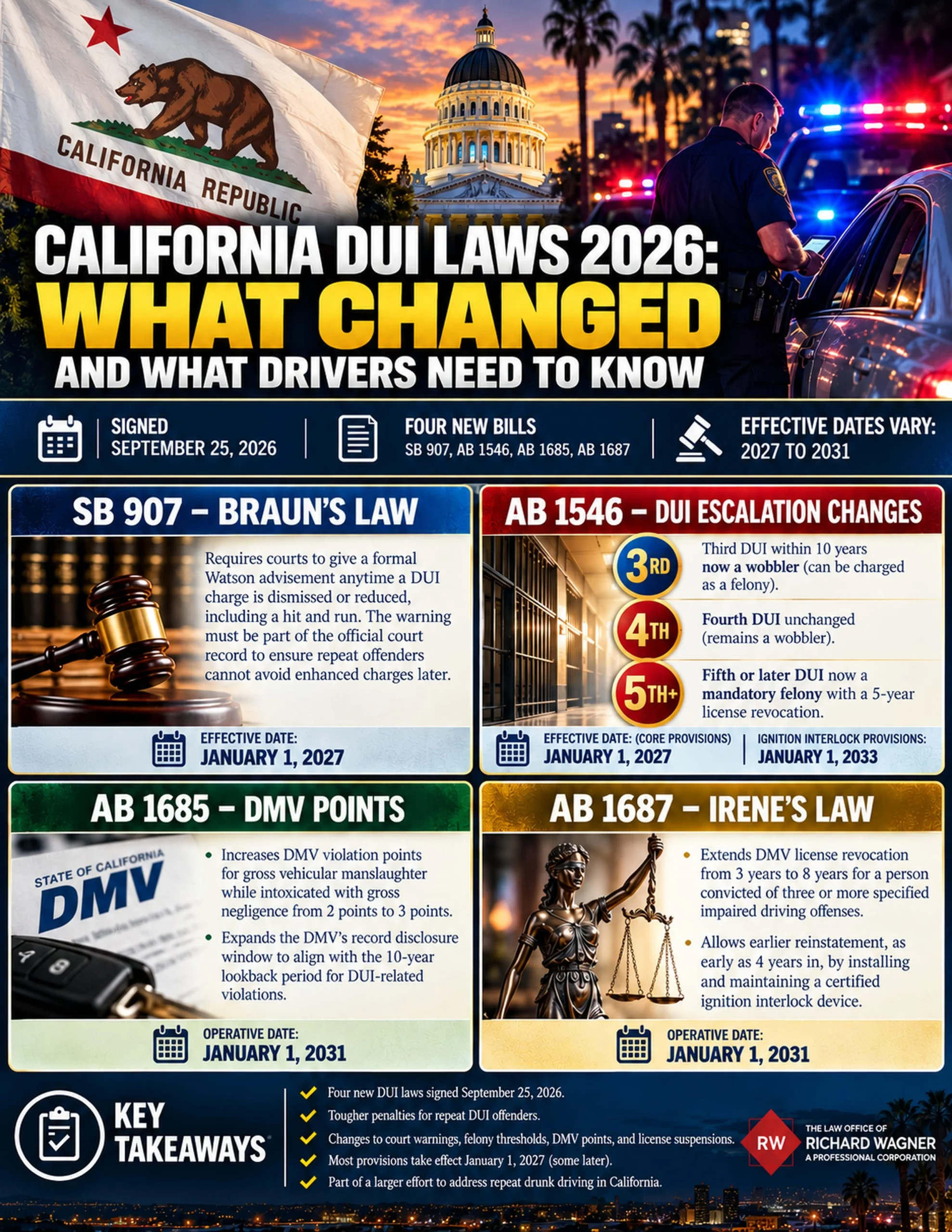
On September 25, Newsom signed a package of four bills aimed at repeat drunk driving offenders: Senate Bill 907, known as Braun’s Law, along with Assembly Bills 1546, 1685, and 1687. The package follows years of advocacy from families who lost loved ones to repeat drunk drivers, along with a CalMatters investigative series that found the DMV was failing to track drivers with vehicular manslaughter convictions, in some cases reissuing licenses to people who had caused fatal crashes while intoxicated.
Two of the four bills are named for victims. Braun’s Law honors Braun Levi, an 18 year old Pacific Palisades student and nationally ranked tennis player killed while walking in Manhattan Beach in May 2025 by a suspected repeat drunk driver. Irene’s Law is named for a 12 year old girl killed by a repeat offender, a case cited repeatedly during legislative testimony. At the signing, the Governor’s office noted the California Highway Patrol has made more than 50,900 DUI arrests so far in 2026.
Not every provision takes effect right away. Two of the four bills do not become operative until 2031, since Newsom’s own signing message acknowledged the DMV does not currently have the tracking system needed to enforce them, and directed the legislature to build one.
SB 907, Braun’s Law: The First of the New California DUI Laws
Braun’s Law requires courts to issue a formal warning, known as a Watson advisement, any time a DUI charge is dismissed or reduced to a lesser offense, including a hit and run. The name comes from a 1981 California Supreme Court case that first established a driver who kills someone while impaired can be charged with murder if they were previously warned about the dangers of drunk driving.
That warning has historically been inconsistent and poorly documented, which made it harder for prosecutors to bring a murder charge against a repeat offender whose earlier DUI had been pled down. Braun’s Law closes that gap by making the advisement mandatory and part of the official court record every time a DUI charge is reduced or dismissed.
This does not end plea negotiations in DUI cases, and it does not change the penalty for the case being pled down. It changes what happens if that same person is involved in a fatal DUI years later, since prosecutors will now have documented proof the person was formally warned. You can review the full text of Senate Bill 907 on the California Legislative Information site.
Effective date: January 1, 2027
AB 1546: Two Real Changes to the Repeat DUI Ladder
AB 1546 changes two specific points on California’s existing DUI escalation ladder, not the entire structure. Under current law, a third DUI within 10 years is a straight misdemeanor, a fourth DUI is already a wobbler that prosecutors can charge as a felony or misdemeanor, and even a fifth or later DUI remains just a wobbler with no automatic felony tier and a four year license revocation.
- A third DUI within 10 years moves from a guaranteed misdemeanor to a wobbler, giving prosecutors discretion to charge it as a felony
- A fifth or later DUI within 10 years moves from a wobbler to a straight, mandatory felony
- The license revocation period for a fifth or later DUI increases from four years to five years
- The fourth DUI tier itself does not change. It was already a wobbler with a four year revocation and stays that way
In practice, a driver with two prior DUI convictions who picks up a third after January 1, 2027 now faces a wobbler instead of a guaranteed misdemeanor. A driver with four or more prior convictions loses any possibility of a misdemeanor outcome and faces a longer revocation on top of it. A separate provision inside the same bill extends the required length of ignition interlock device installation for certain repeat convictions, but that piece does not become operative until January 1, 2033. The full text is available under Assembly Bill 1546.
Core provisions effective: January 1, 2027 | Ignition interlock provision operative: January 1, 2033
AB 1685: More DMV Points for Intoxicated Manslaughter
AB 1685 raises the DMV violation point penalty for gross vehicular manslaughter while intoxicated with gross negligence from two points to three, and expands the window during which the DMV must make these conviction and crash records available for review, aligning it with the same 10 year lookback period used for DUI-related violations generally.
DMV points affect license suspension risk under the state’s negligent operator system, separate from whatever penalty a court imposes. This provision does not take effect until it becomes operative in 2031, tied to the same DMV tracking system delay affecting AB 1687.
Operative date: January 1, 2031
AB 1687, Irene’s Law: License Revocation Jumps From 3 Years to 8
AB 1687 targets the license side of repeat DUI cases directly. Once operative in 2031, the DMV can revoke a driver’s license for eight years, up from the current three year revocation, once a person is convicted of three or more specified impaired driving offenses. The bill also blocks reinstatement before that eight year period expires, though a person may apply for earlier reinstatement, potentially as soon as four years in, by installing and maintaining a certified ignition interlock device.
This is a straightforward extension tied to a third qualifying conviction, not a narrower rule limited to injury causing cases, despite some early reporting suggesting otherwise.
Operative date: January 1, 2031
What Hasn’t Changed Yet Under the New California DUI Laws
- AB 1685 and AB 1687 will have no legal effect on any case for more than four years
- Neither the DMV point increase nor the extended eight year revocation applies to a case resolved today
- SB 907 and the core provisions of AB 1546 take effect January 1, 2027, so a case resolved before that date is unaffected by either
- None of these four laws lower California’s 0.08 BAC limit, add new categories of DUI offense, or change how a first or second DUI is charged
Outside of these two provisions, the new California DUI laws largely target people with prior convictions, not first-time offenders.
A Quick Glossary
- Watson advisement: A formal warning given to a DUI defendant that driving impaired again in the future, if it causes a death, could be charged as murder. Named after the 1981 case that first established the rule
- Wobbler: A criminal offense that can be charged as either a felony or a misdemeanor at the prosecutor’s discretion, based on the facts of the case and the defendant’s record
- Qualifying conviction: A prior DUI-related conviction that falls within the relevant statute’s lookback window, currently 10 years for most repeat offender provisions
- DMV violation points: Points assessed against a driver’s record used to determine license suspension risk, separate from any criminal court penalty
- Ignition interlock device (IID): A breath testing device installed in a vehicle that prevents the engine from starting if it detects alcohol on the driver’s breath
What This Means If You Are Facing a DUI in Orange County Right Now
- If this is your first or second DUI, none of these four laws increase your maximum exposure
- If you have one or more prior DUI convictions within the past 10 years, the felony threshold is moving closer to you starting in 2027, not further away
- If a plea deal is on the table, expect a documented Watson advisement to become standard practice for any reduced or dismissed DUI charge after January 1, 2027
- The DMV point increase and extended eight year revocation do not apply to any case resolved before 2031
- Whether a specific prior conviction actually qualifies under these statutes is often a real, litigable question, not a simple count
Timing and prior record are what determine whether the new California DUI laws actually touch a given case. Richard Wagner reviews both when evaluating a new DUI matter, since a case that looks routine on the surface can carry very different exposure depending on what is already on a client’s record and exactly when those prior convictions occurred.
An Arrest and a Charge Are Not a Conviction Under the New California DUI Laws
- Every provision above attaches to a conviction, not an arrest or a filed charge
- The legality of the stop, the reliability of chemical testing, and the accuracy of a prior conviction’s qualifying status can all still be challenged
- A prior conviction used to trigger a wobbler, felony, or extended revocation must actually fall within the statute’s 10 year window, and that window is frequently disputed
Orange County DUI Defense Insight
- Reviewing whether a prior conviction genuinely qualifies within the 10 year lookback period
- Challenging the underlying case before a repeat offender enhancement can attach to a new charge
- Understanding how a Watson advisement changes future exposure before agreeing to any plea
- Evaluating how DMV point and revocation exposure interacts with a pending criminal case
Learn more about DUI defense:
- Second DUI Offense Penalties
- Third DUI Offense Penalties
- Felony DUI and DUI Causing Injury
- Understanding Plea Deals in California
- Top 30 California DUI Laws (2026) Guide
DUI Defense Resource Center
- In California, you have only 10 days to request a DMV hearing after a DUI arrest
- Missing that window can mean an automatic license suspension before the criminal case is even resolved
- Early legal action can change the outcome of both the DMV case and the criminal case
Frequently Asked Questions
What are the new California DUI laws?
The new California DUI laws are four bills signed September 25, 2026: SB 907 (Braun’s Law), requiring courts to warn defendants before a DUI is pled down; AB 1546, raising penalties at the third and fifth DUI tiers; AB 1685, increasing DMV points for intoxicated manslaughter; and AB 1687 (Irene’s Law), extending license revocation for repeat offenders.
When do these new DUI laws take effect?
SB 907 and the core provisions of AB 1546 take effect January 1, 2027. A separate ignition interlock provision within AB 1546 is operative January 1, 2033. AB 1685 and AB 1687 do not become operative until January 1, 2031.
Does a third DUI automatically become a felony now?
No. Under AB 1546, a third DUI within 10 years moves from a straight misdemeanor to a wobbler, meaning prosecutors gain the discretion to charge it as either a felony or a misdemeanor. A DUI conviction only becomes an automatic, mandatory felony at the fifth offense within that window. A fourth DUI was already a wobbler under existing law and is not changed by AB 1546.
What is a Watson advisement?
A Watson advisement is a formal warning, named after a 1981 California Supreme Court case, that tells a defendant a future impaired driving death could result in a murder charge. Braun’s Law makes this advisement mandatory any time a DUI charge is dismissed or pled down, starting January 1, 2027.
Who is affected by AB 1687’s longer license revocation?
Once operative in 2031, a person convicted of three or more specified impaired driving offenses faces an eight year DMV license revocation instead of the current three year revocation, with the option to apply for earlier reinstatement by installing an ignition interlock device.
Do these changes affect someone facing a first-time DUI charge today?
No. These laws are aimed at repeat offenders. A first or second DUI charge carries the same exposure it did before this package was signed.
Why don’t AB 1685 and AB 1687 take effect until 2031?
Governor Newsom’s signing message noted that California’s DMV does not currently have the centralized tracking infrastructure needed to enforce these provisions accurately, and directed the legislature to pass interim legislation to build that system before the laws become operative.
Does a prior DUI conviction always count against you under these new laws?
Not automatically. Whether a specific prior conviction falls within the qualifying 10 year window, and whether it meets the statute’s definition of a qualifying offense, is often disputed and can change which penalty tier applies to a new charge.